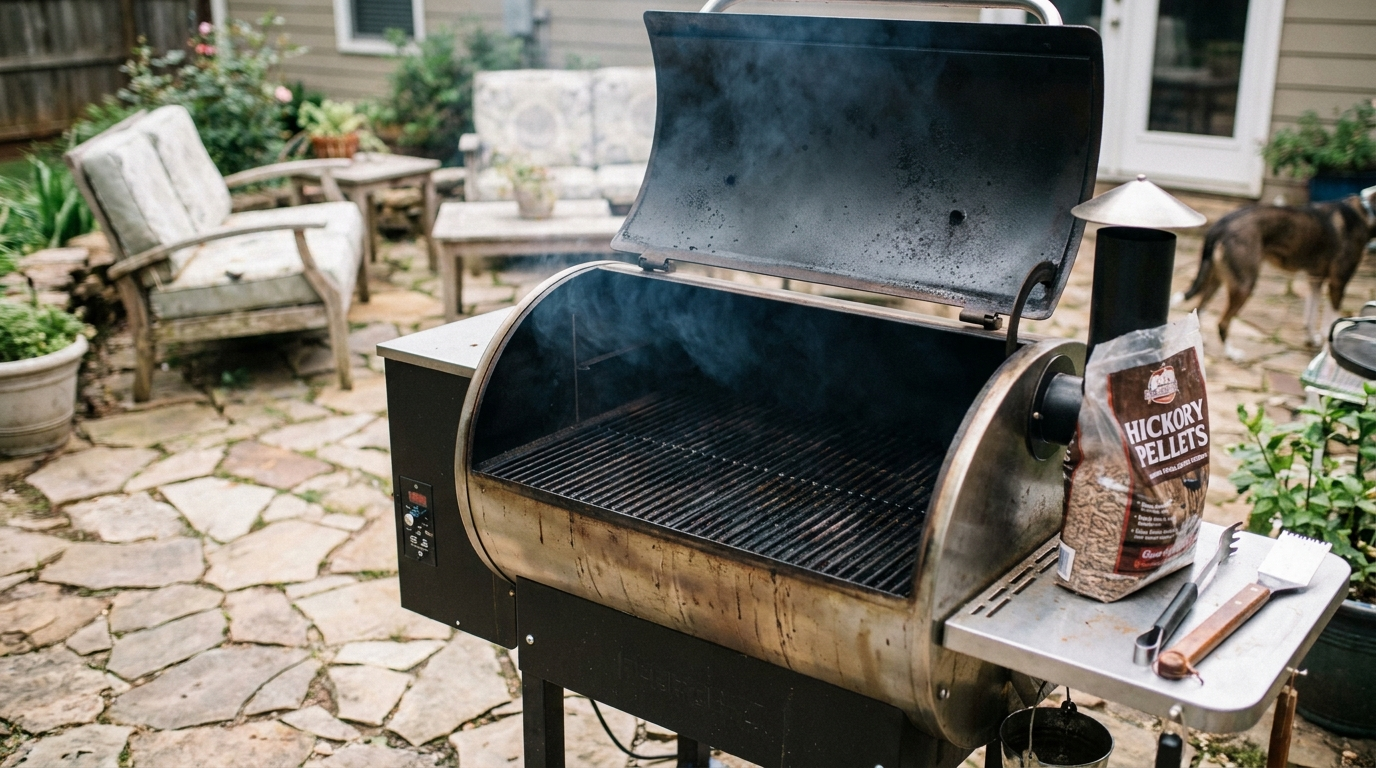
Wood Pellet BBQ Grill: What You Actually Need to Know Before Buying
Disclosure: Some links on this page may be affiliate links, meaning we earn a small commission if you buy through them, at no extra cost to you.
A wood pellet bbq grill is one of the most genuinely versatile cookers you can own — it smokes, roasts, bakes, and grills all from one unit. But the marketing around these machines makes them sound like they do everything perfectly, and that’s not quite true. There are real trade-offs, and some of them matter a lot depending on how you actually cook.
Here’s what I’ve learned from years of cooking on these things.
How a Pellet Grill Actually Works
Pellets — compressed hardwood about the size of a pencil eraser — are stored in a hopper on the side of the grill. An auger (basically a metal screw) feeds them slowly into a fire pot. A hot rod ignites the pellets, a fan pushes heat and smoke through the cooking chamber, and a digital controller keeps the temperature where you set it.
The result is a convection-style cooking environment. It’s more like an outdoor oven than a traditional grill. That’s important to understand because it changes how you use it.
What pellet grills do exceptionally well:
– Long, low-and-slow smokes (brisket, pork shoulder, ribs)
– Roasting whole chickens, prime rib, turkey
– Consistent, hands-off cooking without constant attention
– Gentle, clean smoke flavor that doesn’t overwhelm
Where they fall short:
– True high-heat searing. Most pellet grills top out around 500–600°F, and some struggle to hold that consistently. A charcoal grill or gas grill gets ripping hot faster and with better contact heat for a proper crust.
– Smoke intensity. Pellet grills produce a mild, approachable smoke. If you want that heavy, campfire-style bark you get from an offset smoker, you’ll be disappointed.
– Running costs. You’re buying bags of pellets continuously, and pellet consumption rises significantly at higher temperatures.
The Features That Actually Matter
PID Controller vs. Non-PID
This is the single most important spec to check, and a lot of buyers overlook it. A PID (proportional-integral-derivative) controller monitors and adjusts temperature in real time with much tighter precision — typically holding within 5–10°F of your set point. Older or cheaper non-PID controllers can swing 25°F or more, which matters when you’re holding a brisket at 225°F for 14 hours.
Nearly all modern mid-range and premium pellet grills use PID controllers now, but check before assuming.
Hopper Capacity
Small hoppers mean you’re refilling pellets during a long cook. For an overnight brisket or a 6-hour pork shoulder, you want a hopper that holds at least 18–20 lbs. Some larger units hold 30 lbs or more. Don’t buy a hopper that’ll have you setting an alarm at 2 a.m.
Direct Flame Access
Some pellet grills have a sliding plate or a dedicated zone that exposes the fire pot directly beneath the grates. This gives you actual flame contact for searing steaks — something a standard pellet grill cannot replicate. If searing matters to you, look specifically for this feature.
Build Quality and Lid Seal
Cheap construction shows up in two places: thin steel that warps over time, and a poorly sealing lid that bleeds heat and smoke. A tight lid seal is especially important for smoking — you want that smoke circulating, not escaping out a gap. Lift the lid in a showroom if you can. It should feel substantial and close with a solid thud, not rattle.
Wi-Fi and App Control
Honestly useful, not just a gimmick. Being able to monitor your cook temperature and meat probe readings from inside the house — or from across town — removes a huge amount of anxiety from long cooks. Most mid-range and premium grills offer this now. Just make sure the app actually works well; some manufacturers have much better software than others.
Pellet Quality Matters More Than You’d Think
The grill is only half the equation. Cheap pellets that contain filler wood, bark, or binding agents produce more ash, clog the fire pot faster, and deliver inconsistent flavor. Hardwood pellets made from a single species — hickory, cherry, apple, oak, mesquite — give you cleaner burns and better smoke flavor.
A few practical notes:
– Fruitwood pellets (cherry, apple) burn faster than dense hardwoods like hickory or oak. You’ll go through a bag quicker.
– Store pellets in a sealed container. Moisture is the enemy — wet pellets swell, jam the auger, and create a mess.
– Don’t buy pellets in bulk and leave them in an open bag in a humid garage all summer.
Sizing: Don’t Underestimate How Much Space You Need
This catches people out. A 500-square-inch cooking surface sounds generous until you’re trying to fit a full packer brisket, a rack of ribs, and a few sausages simultaneously. The brisket alone can take up 300+ square inches depending on its size.
For regular family cooking or entertaining, aim for at least 600–700 square inches of primary cooking space, plus a secondary rack. If you’re cooking for crowds or competing, go bigger.
Also consider the physical footprint. A large pellet grill on a small deck can dominate the space. Measure before you buy.
A Word on Grease Management
Every pellet grill has a grease drain of some kind — a channel that directs drippings away from the fire pot into a bucket or pan. This is important for two reasons: fire safety, and ease of cleaning.
Grease fires in pellet grills happen when the drain system is neglected or poorly designed. Look for grills with a straightforward, easy-to-access grease bucket and a trough that doesn’t have a dozen hard-to-clean angles. Clean it regularly — after every few cooks, at minimum.
Budget Ranges: What You’re Actually Getting
I won’t name specific prices since they shift constantly, but here’s what the tiers generally mean:
Entry-level: Thinner steel, simpler controllers, smaller hoppers, basic or no Wi-Fi. Fine for occasional use and learning the basics. Expect to baby it a bit and replace it sooner.
Mid-range: This is the sweet spot for most backyard cooks. Solid PID control, good build quality, Wi-Fi connectivity, reasonable hopper size. These machines genuinely deliver excellent results and will last years with proper care.
Premium: Thicker steel, superior temperature precision, larger cooking areas, better app ecosystems, and often more advanced features like direct flame access or integrated meat probes with multiple channels. Worth it if you cook frequently, cook for crowds, or just want something built to last a decade.
Common Mistakes First-Time Buyers Make
Buying too small. Almost everyone who buys a small pellet grill eventually wishes they’d gone bigger. Cooking space is never wasted.
Skipping the initial burn-in. Every new pellet grill should be seasoned before you cook food on it — run it empty at high heat to burn off manufacturing residues. Skip this and your first brisket might taste like machine oil.
Expecting it to replace a charcoal grill. A wood pellet bbq grill is its own tool. It doesn’t replace the searing capability of charcoal or the speed of gas. The cooks who get the most out of them understand this and use the right tool for each job.
Not learning the stall. Long smokes on large cuts — particularly brisket and pork shoulder — hit a prolonged temperature plateau (typically in the 150–170°F internal range) where moisture evaporation stalls the cook. This can last hours. New pellet grill owners sometimes panic and crank the heat. Don’t. Either wait it out or wrap the meat in butcher paper.
Making the Decision
A wood pellet bbq grill is the right choice if you want largely hands-off cooking, consistent results, and genuinely good smoke flavor without the constant management that an offset smoker demands. It’s a serious machine that rewards patience and good technique.
If searing is your priority, pair it with a cast iron sear station or keep a charcoal kettle around. If you want heavy, wood-fired smoke, supplement with a smoke tube or wood chunks on high-smoke mode settings.
Buy the largest cooking surface your space and budget allow. Get a model with a PID controller and Wi-Fi. Use quality pellets. Clean the grease drain. Then let the thing do what it’s actually great at — low, slow, and steady — and you’ll get results that justify every dollar.
Leave a Reply