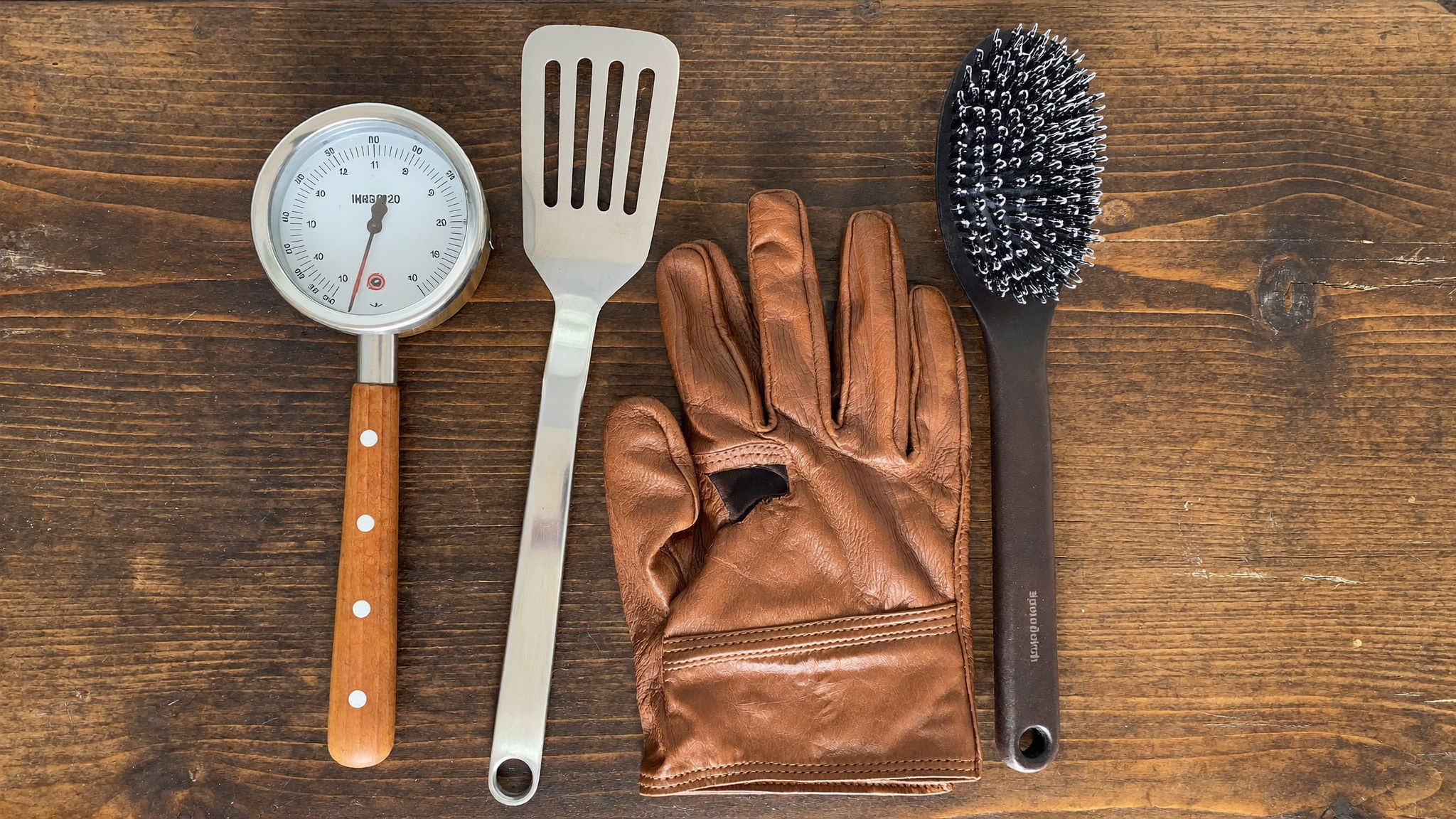
Most grills come with almost nothing useful in the box. A grate and a lid, basically. Everything else — the tools that actually make grilling easier, safer, and more consistent — comes from the grill accessories you add. The problem is the category is enormous and full of gimmicks. A rotating corn rack sounds great until it sits in a drawer forever.
This article cuts through that. Here’s what the useful accessories are, what they actually do, and how to use them well.
The Truly Essential Tools
A Reliable Instant-Read Thermometer
Nothing else on this list matters more. Color guides, time charts, the poke test — they’re all rough approximations. An instant-read thermometer tells you the truth in about two seconds. Stick it into the thickest part of the meat, away from bone, and you get an actual number you can act on.
For burgers, you want 160°F at the center. Chicken thighs hit their best texture around 175°F — yes, above the 165°F safety minimum, because dark meat benefits from the extra few degrees to break down connective tissue. Steaks are personal, but knowing the exact temp means you can pull at 125°F for medium-rare every single time instead of guessing.
Get a thin-tipped model if possible. They read faster and work better on thin cuts like fish fillets and pork chops.
Long-Handled Tongs
The right pair of tongs is your primary hand at the grill. Sixteen inches of handle is the sweet spot — enough distance from the heat, short enough to still have control. Look for a locking mechanism so they store flat, and a scalloped tip that grips without piercing the meat (piercing lets juice out).
Flip steaks with tongs, not a fork. That’s not just food-blogger advice; it’s practical. Every puncture is a juice leak.
A Heavy-Duty Grill Brush or Scraper
A clean grate means better sear marks, less sticking, and food that doesn’t taste like last Tuesday’s salmon. The debate between wire brushes and solid metal scrapers is real — some grills have experienced bristle contamination from worn wire brushes, which is a legitimate safety concern. A solid stainless scraper with no loose parts removes that risk entirely.
Clean the grate while it’s hot, right after cooking, or right before the next session after you’ve preheated. Both approaches work. Cold grate cleaning is mostly a waste of effort.
A Chimney Starter (If You Use Charcoal)
Lighter fluid works. It also leaves a petrochemical taste on food when people use too much, which is most of the time. A chimney starter is the cleaner, faster, more consistent alternative. You fill the top chamber with charcoal, stuff the bottom with newspaper or a paraffin cube, light it, and wait about 15–20 minutes. The coals come out uniformly lit, with no lighter fluid involved.
The capacity of the chimney determines roughly how much coal you can light at once — useful to know for larger cooks.
Accessories That Expand What You Can Cook
A Cast-Iron or Stainless Grill Griddle
A flat griddle insert that sits on your grill grates opens up a wide range of food that a grill can’t handle well otherwise. Smash burgers, eggs, diced vegetables, shrimp, fish with delicate skin — these all cook better on a flat surface than through grill grates where they’d stick, fall apart, or cook unevenly.
Cast iron holds heat exceptionally well once it’s up to temperature, but it takes longer to heat through and needs seasoning maintenance. Stainless is lower maintenance. Either way, preheat the griddle for at least 10 minutes before you cook on it.
Grill Baskets and Perforated Pans
For vegetables and small items, a perforated grill basket is genuinely useful — not the kind with handles shaped like a fish, just a flat perforated pan or a hinged basket. Toss your zucchini, peppers, or asparagus in oil and salt, throw them in the basket, and you can shake and stir without chasing anything through the grates.
The hinged basket style also works well for whole fish. You oil the fish, place it inside, and flip the whole basket at once instead of trying to flip a fragile fillet with a spatula.
A Grill Press
A heavy, flat press sits on top of meat while it cooks. For smash burgers, it’s essential — you press the ball of meat into the griddle or grate immediately after placing it, maximizing contact and getting the crust that makes smash burgers what they are. It also works for chicken thighs, which tend to curl from the heat and cook unevenly. The press keeps them flat against the surface.
This is one of the most underrated grill accessories, mostly because people don’t think about it until they’ve had a burger from a place that uses one.
A Wireless Leave-In Probe Thermometer
Different from an instant-read, a wireless probe stays in the meat throughout the cook and sends temperature readings to your phone or a dedicated receiver. This matters most for longer cooks — a whole chicken, a pork shoulder, a beer-can chicken on a kettle grill. You can walk away, sit down, check the score, and get an alert when you’re approaching target temp.
Some models support multiple probes simultaneously, which is useful if you’re cooking two different proteins at once.
Accessories That Are Situational But Useful
A Cedar Plank or Smoking Wood Chunks
Cedar planks aren’t just aesthetic. Soaking the plank and putting fish or chicken on top of it creates a steaming, smoking microenvironment right under the protein. The smoke flavor is mild and real, not liquid-smoke fake. Works especially well for salmon fillets.
Small smoking wood chunks (different from chips, which burn too fast to be useful) placed directly on charcoal or in a smoker box on a gas grill add actual smoke flavor without setting up a full offset smoker. Apple and cherry wood are mild; hickory is strong. Match intensity to the protein.
A Grill Light
Not glamorous, but once you’ve cooked into the evening regularly, you realize how much you’ve been guessing about doneness by grill shadow. A magnetic or clamp-on grill light with a flexible neck costs almost nothing and removes one variable.
Silicone Basting Brushes
Old bristle brushes shed, and the bristles end up in the glaze. Silicone brushes don’t shed, are easy to clean, and handle high-heat applications without melting. They hold less liquid per dip than bristle brushes, so you apply more coats — which is actually better for building a glaze anyway.
What to Skip
Grill mats that claim to replace everything: they work at lower temps but degrade quickly at high heat and defeat the purpose of direct-flame cooking.
Decorative tool sets that come in a case: they look complete and cost less than individual quality tools. The tongs flex, the spatula is too thin, the brush sheds immediately. Individual, purpose-chosen tools outperform them every time.
Electric charcoal starters shaped like a coil: they work but take longer than a chimney and require an outlet near the grill. A chimney is simpler.
Thinking About It Practically
The best approach to grill accessories is to identify an actual problem you’re having — food sticking, uneven temps, limited food types, no smoke flavor — and find the specific tool that solves it. A thermometer solves temperature guessing. A griddle insert solves the small-food problem. A leave-in probe solves the walk-away problem.
That process leads to tools you use every single cook instead of a crowded cabinet full of things that seemed interesting once. Start with the thermometer. Everything else follows logically from there.
Leave a Reply