Vertical Pellet Smoker: How It Works and What It Does Best
Disclosure: This page may contain affiliate links, meaning we may earn a small commission if you purchase through them, at no extra cost to you.
A vertical pellet smoker is one of the most efficient ways to run a long cook — a full packer brisket, six racks of ribs, or a loaded batch of pork shoulders — without babysitting a fire all day. The design isn’t flashy, but it’s effective in ways that take a few cooks to fully appreciate.
Here’s what’s actually going on inside one, why the vertical format matters, and where these cookers genuinely outperform the competition.
How a Vertical Pellet Smoker Actually Works
The mechanics are straightforward once you see them clearly.
Wood pellets feed from a hopper into an auger — a rotating screw — that moves them at a controlled rate into a firepot at the bottom of the unit. An igniter rod lights the pellets, and a fan pushes combustion air through while also circulating heat and smoke throughout the cooking chamber. A digital controller reads the internal temperature and adjusts the auger speed to maintain your set point.
In a vertical design, that firepot and heat deflector sit at the bottom. Heat rises naturally. Smoke travels upward through multiple cooking grates before exhausting through a vent near the top. You get convection — passive, physics-driven airflow — working with the fan instead of fighting it.
That’s the fundamental advantage. In a horizontal barrel-style pellet grill, heat and smoke have to travel sideways from a firebox. You lose some of that upward convection benefit, and hot spots near the firebox end are a constant management issue. Vertical chambers don’t have that problem in the same way.
The Role of the Heat Deflector
Directly above the firepot sits a heat deflector — usually a cast iron or steel plate. Its job is to scatter direct radiant heat so the food above never gets scorched by direct flame. Instead, heat bounces off the deflector and fills the chamber evenly.
Water pans often sit just above the deflector. This matters. The moisture they add to the cooking environment keeps the surface of the meat humid during the early stages of a cook, which slows bark formation just enough to let smoke penetration happen before the exterior seals off. It’s a subtle but real difference, and it’s one reason vertical smokers often produce exceptionally moist results on long cooks.
Vertical vs. Horizontal Pellet Grill: Real Differences
This distinction gets blurred in marketing, so let’s be direct.
A horizontal pellet grill — the kind that looks like a barrel laid on its side — is primarily designed for grilling and hot-and-fast cooking, with smoking as a secondary capability. Most run well above 400°F and have wide grate surfaces. They’re versatile, but smoke flavor at low temperatures is often lighter than dedicated smoker users want.
A vertical pellet smoker is built around low-and-slow. Temperature ranges typically start around 150–160°F and top out around 300–325°F. There’s no high-heat searing capability. What you get instead is a taller, more compact footprint with multiple rack levels — sometimes four to six grates — that dramatically increase usable cooking area relative to the unit’s floor space.
If you want to smoke three full briskets at once and don’t care about searing a steak afterward, a vertical pellet smoker is almost certainly the better tool. If you want one unit that grills burgers on Tuesday and smokes ribs on Saturday, a horizontal pellet grill makes more sense.
What Cooks Best in a Vertical Pellet Smoker
Ribs
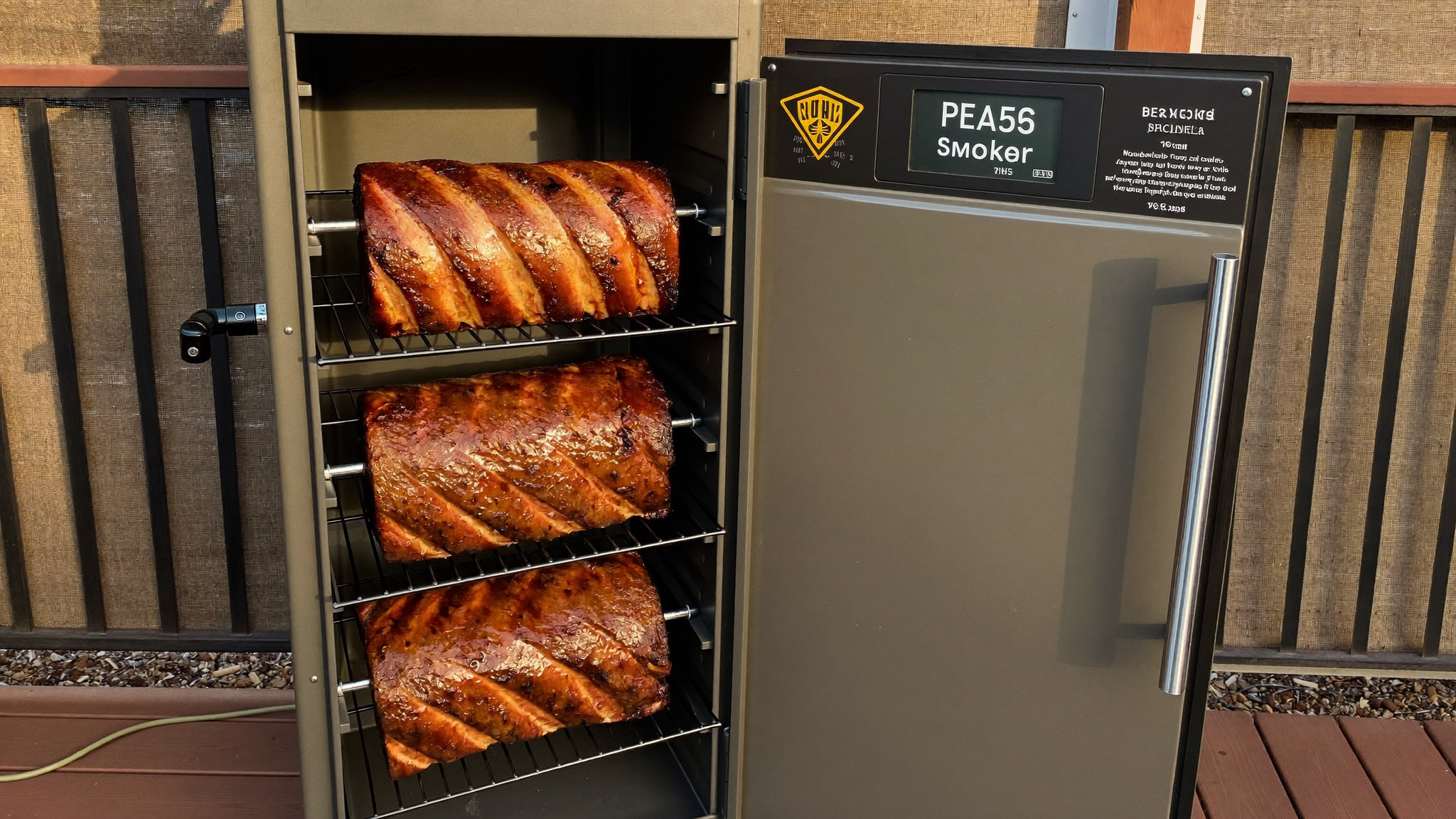
This is where the vertical format shines most obviously. You can hang ribs vertically from hooks (on models designed for it) or lay them flat across multiple racks. Either way, the even heat distribution means every rack finishes at roughly the same time. No rotating. No moving racks around. The rib closest to the top cooks as consistently as the one at the bottom.
Pork Shoulder and Brisket
Both of these cuts want low, consistent heat for many hours. A vertical pellet smoker is good at exactly that — holding 225–250°F for 12, 14, even 18 hours while burning through pellets at a predictable rate. Modern controllers are accurate enough that temperature swings are minor. You can sleep through a brisket cook without the anxiety that comes with managing a charcoal offset.
Whole Poultry and Sausage
Vertical airflow is surprisingly good for whole birds and linked sausages. Heat surrounds the meat from below while rising evenly around the sides. On models with hanging hooks, sausage links hang freely so smoke reaches the entire surface — something that’s harder to achieve lying flat on a grate.
Cold Smoking and Jerky
Some vertical pellet smokers can reach temperatures low enough for cured fish, jerky, and cold-smoke applications like cheese. Not all can — this depends on how low the controller actually goes and whether the unit holds that temperature consistently in warm outdoor conditions. If cold smoking matters to you, confirm the actual minimum temp before committing to a unit.
Capacity: The Underrated Advantage
Let’s talk square inches honestly. A mid-size vertical pellet smoker might offer 700–1,000+ square inches of total cooking space in a footprint roughly the size of a kitchen trash can. That’s a lot of meat for a small deck or patio. The vertical stacking means you aren’t spreading out horizontally — you’re going up.
For anyone who smokes for crowds, competition cooks, or freezer-stocking sessions, this capacity-to-footprint ratio is genuinely valuable. You’re not buying a unit that dominates the entire back porch just to smoke a few racks of ribs.
Pellet Consumption and Run Time
Vertical chambers are generally fuel-efficient. The compact, insulated cooking environment loses heat more slowly than an open barrel grill, so the auger doesn’t have to run as hard to maintain temperature. On a moderate-temperature cook in mild weather, expect a full hopper to last a solid session without needing a refill mid-cook.
Cold weather changes the math. In sub-freezing conditions, any pellet smoker works harder to maintain temperature. Insulated blankets designed for smokers help considerably, and many vertical units accept them due to their cylindrical or rectangular profile.
Smoke Flavor in a Vertical Pellet Smoker
This is a common skepticism about pellet smokers generally — do they produce real smoke flavor? The honest answer: yes, but different from a stick-burner.
Pellets combust cleanly, which means the smoke they produce is relatively thin and blue. That’s actually what you want — thick white smoke is incomplete combustion and produces acrid, bitter results. The flavor from a pellet smoker is lighter and cleaner than a wood-fired offset, but it’s present and real.
In a vertical design, that smoke has to travel past multiple racks of food before it exits. More contact time generally means more smoke absorption, especially during the first few hours of a cook when the meat surface is still cool and tacky. Some pitmasters add a smoke tube packed with pellets or wood chips to the bottom of the chamber for extra output during those early hours. It works.
Maintenance That Actually Matters
The firepot fills with ash. Clean it regularly — after every two or three cooks at minimum. Ash buildup can cause ignition failures and temperature instability.
The grease management system needs attention too. Drippings run down to a collection point — usually a bucket or tray. Let it overflow and you have a fire risk. Empty it before it becomes a problem.
The cooking grates and interior walls will accumulate grease over time. Wipe down the interior after every few cooks. It extends the life of the unit and prevents off-flavors from carbonized buildup.
Is a Vertical Pellet Smoker Right for Your Setup?
If long, low-temperature cooks are most of what you do — and especially if you need to cook large quantities — a vertical pellet smoker earns its space. The efficiency, capacity, and consistent temperature make it purpose-built for the job.
If you want more flexibility — grilling, searing, smoking — a horizontal pellet grill or a combination setup makes better sense.
One approach that works well: a horizontal pellet grill for everyday grilling and hot-and-fast cooks, paired with a vertical pellet smoker for serious smoke sessions. The footprint of a vertical unit is small enough that running both isn’t unreasonable if you have any dedicated outdoor cooking space.
Either way, the vertical format is built around a simple principle — let physics do the work. Heat rises, smoke follows, food gets cooked evenly from bottom to top. It’s an old idea executed with modern automation, and it still works.
Leave a Reply